
New York Resident Lookup Records
New York keeps no single resident roll covering its 62 counties. The five county equivalents inside New York City keep their own systems too. So a resident lookup has to start with the record type. Voter registration, parcel ownership, and court-party entries each capture a different person at a different moment. Matching a name across those sources takes care. Similar names often belong to entirely unrelated records in the residents directory.
| Record | What It Confirms | Where | Access |
|---|---|---|---|
| Voter registration | Current registration and election details for the voter | NYS VoterLookup; county Board of Elections | Self-service status check; board handles corrections and list access |
| Civil case index | A party name, court, filing year, and case status | WebCivil Supreme or WebCivil Local | Online metadata; clerk or court for files and certified papers |
| Criminal history search | An OCA-certified name-and-date-of-birth search result | OCA CHRS | Paid individual search by mail or in person |
| Genealogy vital record | Eligible historical birth, death, or marriage record | NYSDOH Vital Records or local registrar | Form, proof, and age rules apply |
| Assessment or deed | Parcel ownership fields or a recorded transfer | Local assessor and county clerk; NYC uses City Register/DOF | County or city portal, counter, or custodian request |
| Unclaimed funds | A possible property claim linked to a name or organization | NYS Comptroller Office of Unclaimed Funds | Free search; claim review requires supporting documents |
| Business or license | A public filing or license role and its stated status | DOS entity search or License Center | Public search; underlying records may need a separate request |
Let the question pick the record. Registration status points to voter rolls. A court matter points to party filings and their dates. An older family question points to vital records. Whatever the source, treat each result as a lead with a date attached, then confirm it against a record kept elsewhere.
New York Voter Lookup Fields
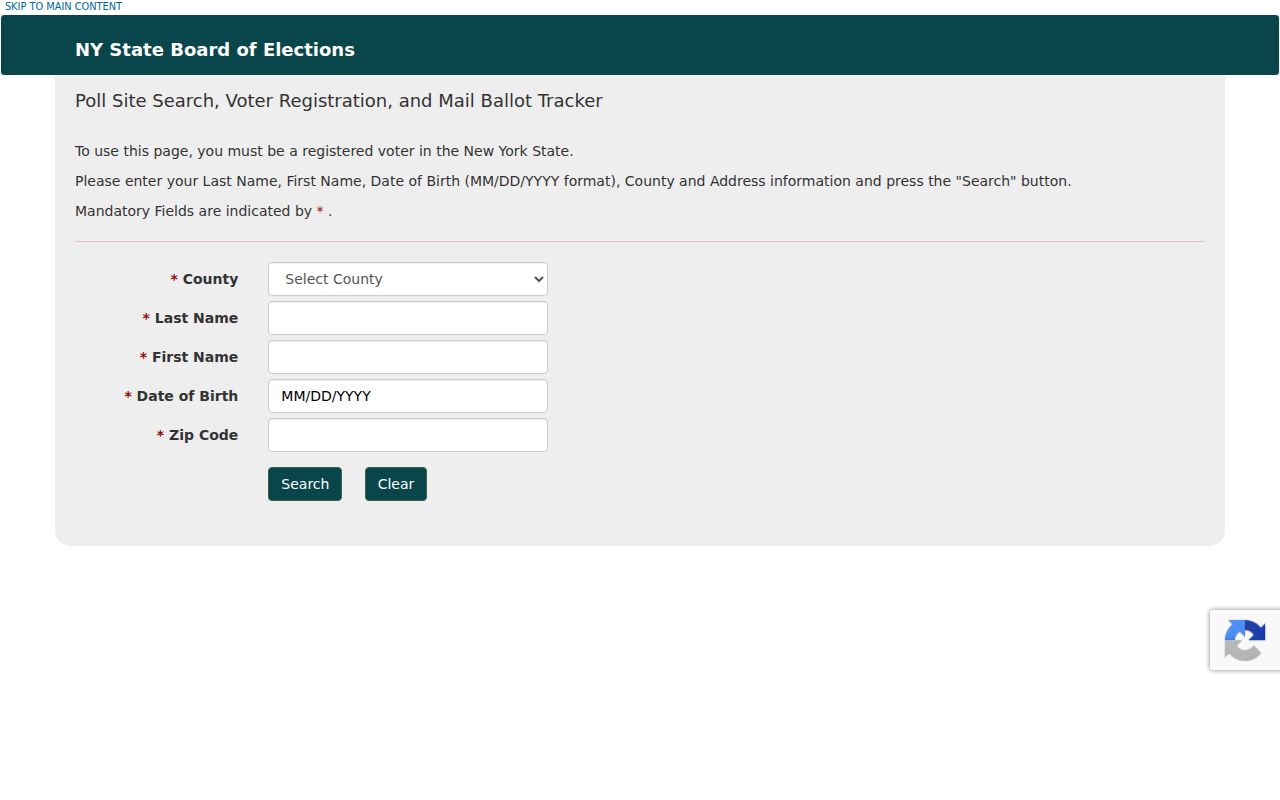
The NYS VoterLookup form serves one voter at a time. It answers registration status, polling-site details, and mail-ballot tracking. It stops there. No reverse lookup, no bulk export, no resident directory. The portal also requires cookies and JavaScript before it will respond.
| Field | Type | Required | Format or notes |
|---|---|---|---|
| County | Dropdown | Yes | Select the county where the voter is registered. |
| Last name | Text | Yes | Enter the name as registered. |
| First name | Text | Yes | Enter the name as registered. |
| Date of birth | Date/text | Yes | Use MM/DD/YYYY. |
| ZIP Code | Text | Yes | Use the ZIP attached to the registration. |
| Search | Button | Yes | Submit the completed self-service query. |
| Browser | Cookie and JavaScript settings | Yes | Both must be enabled. |
The New York VoterLookup page shows its search fields plainly. Name, county, birth date, and ZIP code all come first. Nothing returns until those are filled.
The county Board of Elections is the place to start for corrections. Staff there also handle requests for complete lists or older voter rolls. Inspection requests, copies, poll books, and any distribution rules go through the same office. When you ask, give the county, the election district or municipality, and the election date. That detail lets them pull the right voter rolls. Confidentiality provisions in the Election Law shield certain qualifying records. An empty result in a resident lookup does not mean the person never registered.
New York Court Lookup Options
WebCivil Supreme lists past, present, and future civil Supreme Court metadata; WebCivil Local covers participating local civil courts. Supreme has index, party, attorney/firm, justice, calendar, document, and eTrack modes. Local has index, party, attorney/firm, judge, calendar, and eTrack.
| Search field or control | WebCivil Supreme | WebCivil Local | Required / format notes |
|---|---|---|---|
| Search mode | Index, party, attorney/firm, justice, calendars, documents, eTrack | Index, party, attorney/firm, judge, calendars, eTrack | Select the mode that fits the available details. |
| Index number | Required only for index search | Full index or case-type, court-code, number, and year fields | Short local numbers can match more than one court. |
| Party name and role | Plaintiff/petitioner, defendant/respondent, other, or all roles | Plaintiff, defendant, or either | Name search; roles narrow the match. |
| Alternate name route | Attorney/firm or justice | Attorney/firm or judge | Optional search routes. |
| Court | One or more courts | One or more local courts | Optional; adding courts can slow a Supreme search. |
| Filing year and case type | Filing year | Filing year and case type | Optional filters; use the portal's live case-type list. |
| Status | Open (active or restored) or all | Open (active or restored) or all | Optional. |
| Future appearances | Yes or no | Yes or no | Optional calendar filter. |
| Sort | Portal dropdown | Portal dropdown | Options are rendered by the live portal. |
| Output | HTML or PDF | HTML or PDF | Documents may require a separate index-number search. |
Treat any result as metadata only. It proves nothing about identity, residence, or how a case ended. Sealed files stay hidden. Apply the court and year filters before anything else, since selecting too many Supreme courts slows a search and a shortened Local index can span multiple courts. For the file itself or a certified document, use a counter terminal. Or ask the clerk.
New York Criminal History Search
New York's Office of Court Administration runs a Criminal History Record Search. It sits apart from WebCivil. The electronic search works by name and date of birth. It spans all 62 counties and costs $52 per person. Every alias or extra date of birth counts as a separate search. Note: the OCA-certified result is not a court-issued certificate of disposition.
Mail a full name and date of birth. Or bring the form in person to 25 Beaver Street, Room 840, New York, weekdays from 9:30 a.m. to 4:30 p.m. Hand delivery before 11:30 a.m. aims for next-business-day completion. Mailed requests require a self-addressed, postage-paid envelope. Questions go to 212-428-2943 on weekdays from 10 a.m. to 4 p.m. The fax number is 212-428-2810.
A party hit is just a lead. Pull the county, court, number, and year from it. Then ask the clerk for the file or the disposition. Restricted and sealed cases may never appear.
New York Vital Records Access
Genealogy requests to NYSDOH work through application DOH-4384, which applies age rules. A birth record must be on file 75 years. Deaths and marriages both wait 50 years, and marriages require both parties deceased. A direct-line descendant with documentation can request a waiver. An agent must show proof of authority before acting.
- Birth: name at birth, file number if known, date and place, father, and mother's maiden name.
- Marriage: both parties' names, file number if known, and date and place of marriage or license.
- Death: name at death, date, age, place, parents, spouse, and file number if known.
- Applicant: contact details, purpose, relationship, capacity, signature, and date.
The state charges $22 to search a one-to-three-year span. Longer searches extend through 61-70 years, and fees for no-record searches stay with the office. Pay by signed check or money order, never cash. Mail it to NYSDOH Vital Records Section, Certification Unit, P.O. Box 2602, Albany, NY 12220-2602.
Certified copies of current records follow tighter eligibility rules. They come from either the state or the local registrar, depending on where the event occurred. Order them online where offered, by mail, or in person. A local registrar or city clerk can handle in-person requests. Call or email that office first about ID and eligibility. For older events, library indexes, newspapers, church registers, and cemetery records often supply useful leads.
State birth and marriage files begin in 1881, with deaths starting in 1880. Records from Albany, Buffalo, and Yonkers before 1914 stay local. NYSDOH holds no ordinary NYC records, except Queens and Richmond births from 1881-1897. Divorce records remain restricted for 100 years after the final decree. For historical questions, State Archives guidance points researchers in the right direction.
New York Resident Identity Checks
A court party, a tax-mail recipient, an assessed owner, a voter, a licensee, a historical occupant, and a relative are separate roles. One role never proves another. A tax mailing address can differ from the parcel itself, and a business agent or license address is no proof of residence.
- Write down the full name and variants, likely county or municipality, time period, and the specific question.
- Choose the narrowest official source: voter status, court family, vital event, parcel, license, or older directory.
- Compare a second record family, such as a case county and DOB, a deed and legal description, or a vital record and family names.
- Read the actual result or document, then ask its custodian for a correction, certified copy, or access decision.
- Docket
- A court's running record of filings, events, and status in a case.
- Index
- A finding aid with names and reference details; it may not include the document image.
- Certified copy
- A copy formally authenticated by the office that holds the record.
Court results carry details worth reading closely. The index number, party role, court and county, filing year, attorney or judge, status, and appearance filter all help define what turned up. Remember, the summary is not the file, order, or final outcome.
- Index number: the key used to identify the court file.
- Party name and role: plaintiff or petitioner, defendant or respondent, other, or all roles.
- Court and filing year: the venue and time marker for routing the case.
- Attorney or justice/judge: alternate party-search details shown by the portal.
- Case status and future appearance filter: the selected case and calendar context.
- HTML or PDF output: a summary; filings and the underlying court file may be separate.
New York Heir Search Leads
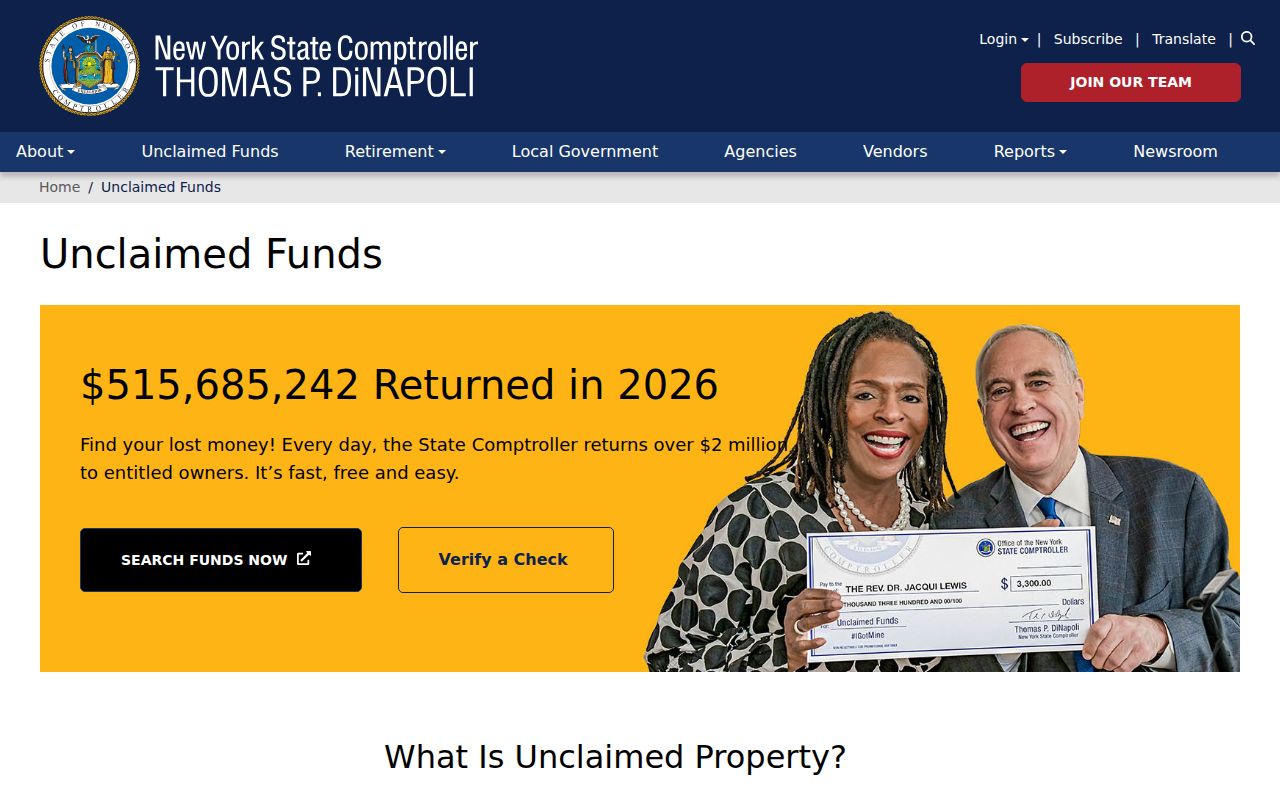
The NYS Comptroller's Office of Unclaimed Funds runs a free search by name or organization. A hit may include a Property ID. State material counts more than 55 million accounts, some dating to the 1940s. A match can guide family research, yet a similar name alone proves nothing about ownership.
Claiming for a deceased owner takes more work. You need authority and relationship records plus death documentation. Paper claims may also call for a notarized certification, photo ID, and supporting papers mailed to 110 State Street, Albany, NY 12236. Confirm the Property ID with the Comptroller. Both searching and claiming through the state are free.
The Comptroller's search page holds the official name or organization lookup and the claim route.
A name match is a lead, not proof of kinship or ownership.
New York Record Privacy Limits
Some New York records simply stay closed. Adoption records are sealed under Domestic Relations Law §114 without a court order. Divorce records stay restricted for 100 years after the final decree. Qualifying voter records can be confidential, and courts may seal files. A public residents directory or index does not override any of these limits.
Safety options exist. Eligible survivors and covered household members can apply to the New York Address Confidentiality Program. It provides a substitute mailing address. Enrolling does not erase every prior deed, court docket, vital record, archive, or old scan. A protected voter record, a court file, and a vital record each remain. They follow their own process.
Use records lawfully. Keep a search tied to a legitimate personal, family-history, estate, or civic question. Do not use names or addresses to stalk, harass, intimidate, or expose a protected person; for immediate safety concerns, contact local authorities or an advocate.
Spot an error in a record? Save its reference number and date first. Then contact the office that created or maintains it. FOIL, under New York Public Officers Law Article 6, can request an existing agency record, but it cannot unseal court material or open restricted vital and voter records to a resident lookup.
New York Resident Lookup Confirmation
For corrections, ask the county clerk, court, registrar, or Board of Elections that holds the record. For copies, ask that same office. A FOIL request for an existing agency record must be acknowledged, granted, or denied. The deadline is five business days. An acknowledgment includes an estimated completion date. Photocopies generally run no more than 25 cents per page up to 9 by 14 inches. Exceptions and media costs are possible. Appeals are due within 30 days.
A good copy request states the record type, name or parcel, county, and date range. It also gives the index number. Keep the source, date, and role together when you read results. A voter entry is not current occupancy. A case summary is not an outcome. Confirm what the custodian's record actually establishes before drawing conclusions from any resident lookup.